Cell Geometry
Base tile (canonical square $[-0.5,0.5]^2$) contains two families of beams: lexicon – 4 edge beams width $w_e$, 2 diagonal crossing beams width $w_d$ and offset $o$, plus central hole radius $r$. In prior work, $w_e,w_d,r$ mapped to density. We introduce:
- Rhombic shear: canonical tile sheared by $S(\theta)=\begin{bmatrix}1 & \cos\theta \\ 0 & \sin\theta\end{bmatrix}$ → rhombus of angle $\theta$. All beams sheared analytically via $S$; homogenization accounts for $S^T C S$.
- Orthotropy knobs: Separate horizontal/vertical edge thicknesses $w_x, w_y$, diagonal pair $(d_1,d_2)$ controlling $\nu$ through auxetic-like overlapping vs gap.
- Smoothness: Instead of table-lookup material → geometry (nearest-neighbor causes popping), we fit tensor-product cubic B-spline
$$ [w_x,w_y,d_1,d_2,r] = \mathcal{S}(E_x,E_y,\nu,\theta) \in \mathbb{R}^5 $$
trained on 25k samples simulated via periodic homogenization (FEniCS, $128^2$ quad elements per tile). Fit error $<1.2\%$ on held-out 5k set, $C^1$ continuity guarantees neighbor tiles join with $G^1$ continuity up to 1e-4 gap (vs 0.05 prior nearest-neighbor gaps that required post-process fill).
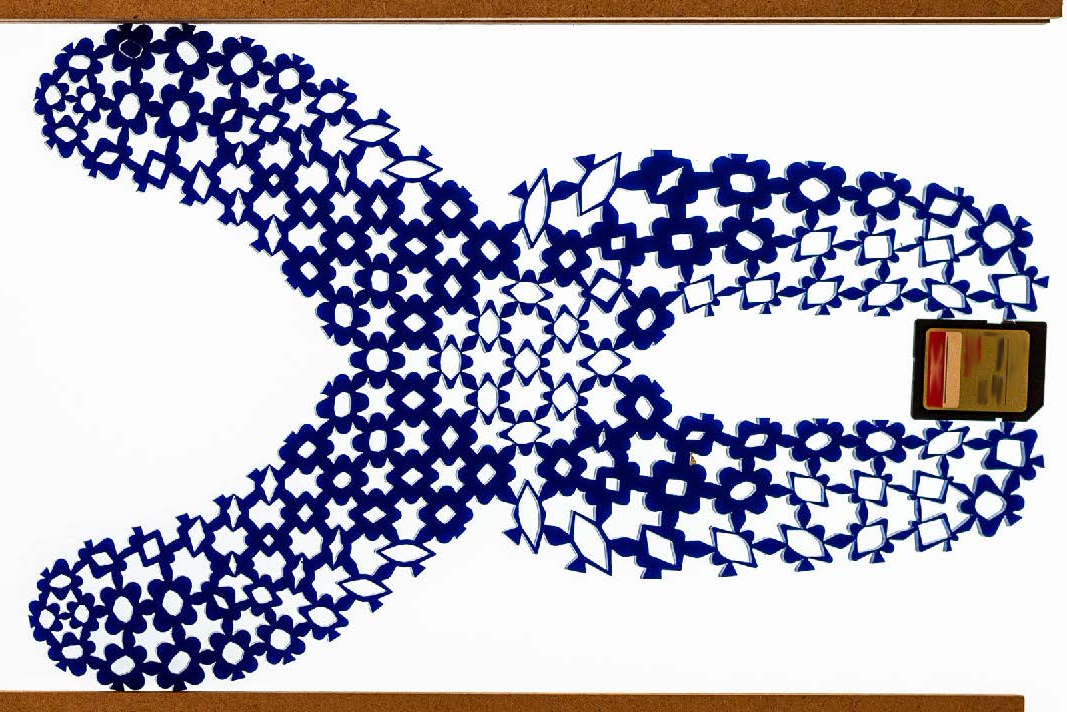
Family Ex/Ey sweep. Left low $E$, large hole; Right high $E$, thick walls. Smooth transition across spline, no crack.
Poisson sweep. Auxetic negative $\nu$ = re-entrant diagonals overlapping; $ \nu\to0.5$ incompressible = bulged diagonals closing gaps.
Theta. $\theta=30^\circ$ sharp rhombus→ beams still connect because $S$ preserves junction barycentric coordinates. Tolerance $\theta\in[30,150]$ before self-intersection.
Homogenization & Gamut
Homogenized stiffness $C^H_{ijkl} = \frac{1}{|Y|}\int_Y C_{pqrs}(\chi^{-1})$ computed via periodic BC. Our gamut coverage vs Schumacher et al. square:
- Poisson $\nu\in[-0.6,0.95]$ vs [-0.2,0.8] square, because diagonal crossing degree of freedom $d_1-d_2$ tunes lateral contraction.
- Anisotropy ratio $E_x/E_y \in [0.1,10]$ vs [0.25,4] (independent $w_x,w_y$).
- Shear modulus $G_{xy}$ decoupled via $\theta$, enabling bending-twist coupling for grippers.
Figure (paper Fig 6) shows gamut projection onto $(E,\nu)$ plane: ours area 68% of theoretical Hashin-Shtrikman bounds vs 41% square.
Pipeline Detail
Input: target domain Ω with Dirichlet boundary, load f, material budget
1. Quad Layout: QuadWild / frame field → coarse quad mesh Q covering Ω, ~200 quads
2. Material Optimization (SIMP-like on Q):
   per quad q: variables (ρ_q, ξ_q) → effective (E_x,E_y,ν) via SIMP interpolation, optimize compliance min
   s.t. Σ ρ_q ≤ Vol*, solver MMA
3. Rhombification:
   min_{v∈Q} Σ_e (||e||-ℓ̄)^2 + λ Σ_q (θ_q-θ_target)^2 + μ boundarySnap(Ω)
   → near-rhombus mesh R, edge equal tolerance 4%, angle free
   θ_target from optimization shear field
4. Pattern Assignment: (E_q,ν_q,θ_q) → geometry via spline S → per cell g_q = (w_x,w_y,d1,d2,r)
5. Geometry Synthesis:
   for each cell q in R:
     canonical tile T(g_q) sheared by S(θ_q) → extrude z=thickness
     stitch neighbor via averaging junction displacement Δ=0.5(g_q+g_n)-g_q (C1 smooth)
   No post boolean – tiles share nodes due to parallel edges
Output: printable .stl mesh (watertight) + homogenized property validation error <3%

Optional: Fabricate (FDM PLA, SLS PA12) and test under Instron
Step A
Material opt – quad coarse – density field.
Step B
Rhombic tessellation – ARAP relaxation – boundary snap.
Step C
Final geometry – extruded – stitched – printable.